Two meals, the same calories, opposite effects on your blood sugar. Almost every tracker calls them identical.
On a GLP-1, eating less is the point. The risk is what goes down with it. When intake falls and protein falls with it, the body spends muscle. A calorie tracker congratulates you for the deficit and never mentions the trade.
How NutriOptio handles GLP-1 →Capture a meal in about three seconds, get a grade you can act on, and let the agents do the arithmetic. Every number is looked up or calculated — never invented.
Point the camera and the meal resolves in about three seconds. Photo, voice, text, barcode or search — five ways in, and correcting an item takes one tap.
Log on a plane or in a basement. Your meal is captured on the device and processed the moment you reconnect, with nothing double-counted and nothing estimated locally.
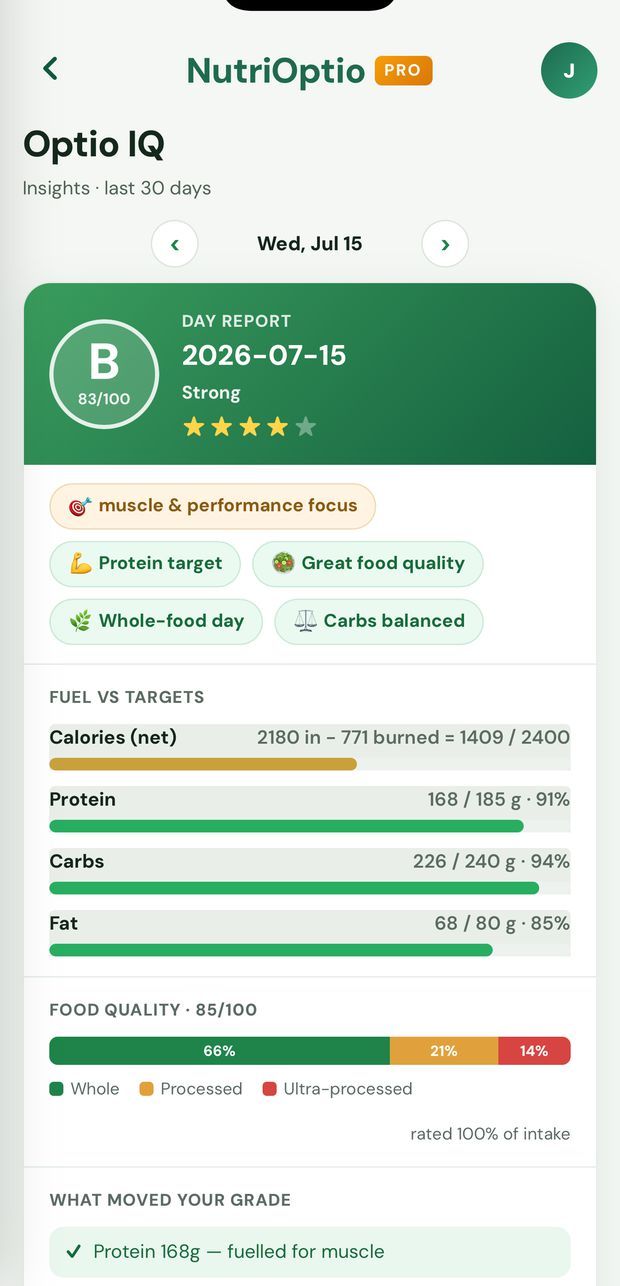
Macros, food quality, calories, activity and glycemic load, weighted by the goals you chose. A score that explains itself instead of a number that just judges you.
Ask what to eat next, why a meal graded the way it did, or how to hit your protein. Grounded in what you actually logged, not generic advice.
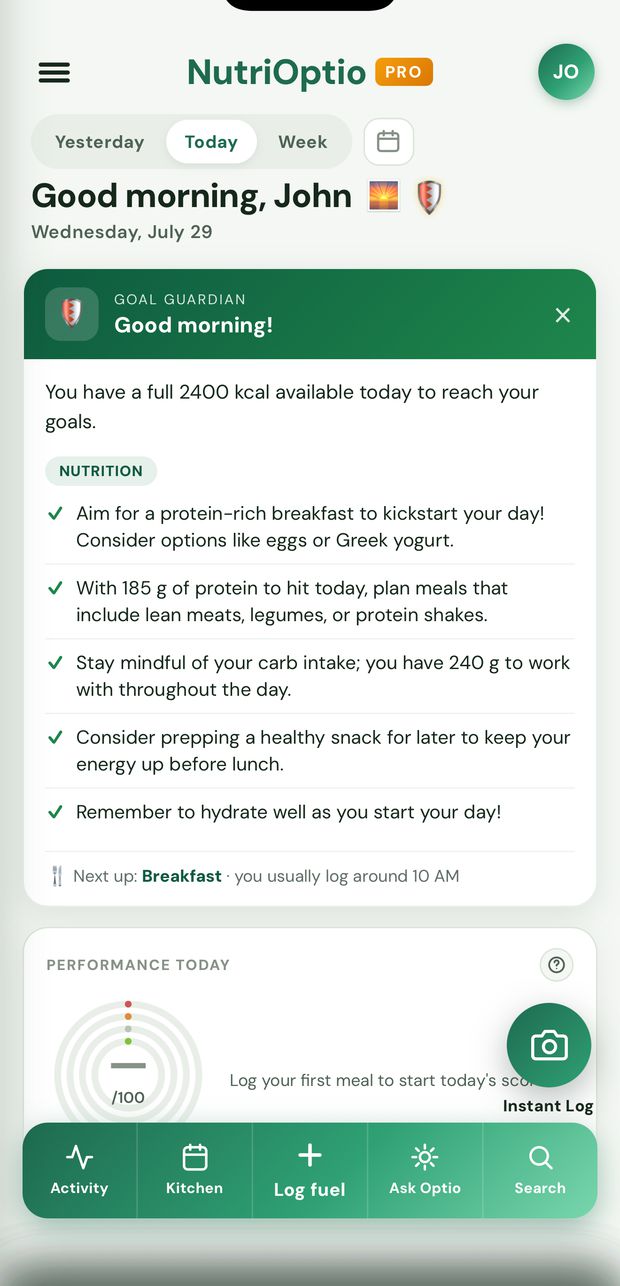
A morning plan and course corrections through the day. The model orchestrates; the code computes every calorie and macro, so it cannot invent a number to fit its argument.
A low grade offers a specific swap, checked against real food data and your remaining calorie and glycemic-load budget — the agent proposes, the code verifies.
Photograph your fridge or a receipt and get a macro-balanced plan built around food you already own, so less of it ends up in the bin.
Reduced-appetite mode leads on protein and food quality, and stops grading a small appetite as a failure. See how it works →
A water target that adapts to your weight, training and protein intake, and workouts that add calories back to the day you earned them.
Diet drives most chronic-disease risk, yet the tools people use to manage it stopped evolving at the spreadsheet. Five failures, and every mainstream tracker has all five.
Wrong macros, zero grams for key nutrients, mismatched serving sizes. You end up cross-checking labels by hand to trust your own totals.
The AI works out what is on the plate. The nutrition facts then come from established food databases and fixed calculations. Same food, same answer, every time.
Searching, portioning, building recipes. And where photo logging exists, mixed dishes get misread and still need heavy editing.
Photo, voice, text, barcode or search. A plate resolves in about three seconds, and correcting an item takes one tap without breaking the maths.
Basics that were free now sit inside $15 to $20 a month subscriptions, while free tiers carry ads heavy enough to slow the app down.
Start for free. We run no advertising at all, which is the reason we do not need your data in the first place.
A fixed BMR number takes no account of what you really did today, so a heavy training day and a desk day are judged identically.
What you actually burned flows in from Apple Health and Health Connect, and pacing is judged against the time of day rather than a verdict at midnight. Recalibrating the baseline from your weight trend is what we are building next.
If you care about glycemic response or ultra-processed food, you are stuck bolting several tools together and researching foods yourself.
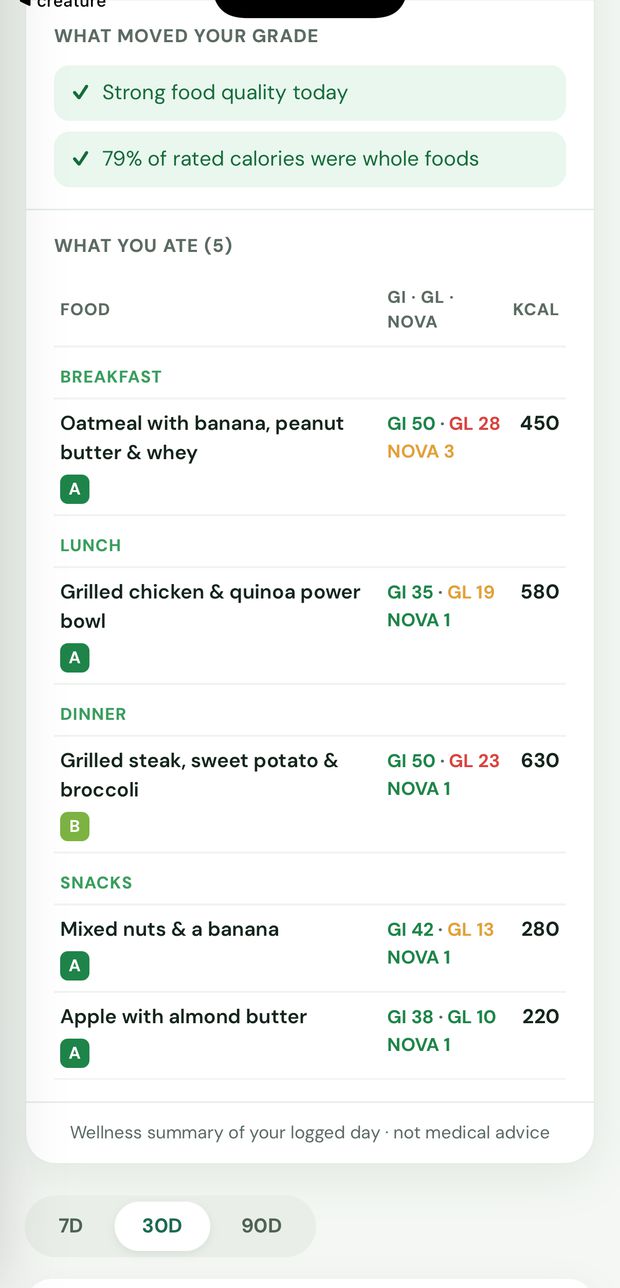
Glycemic Index and Load, Nutri-Score and NOVA on every item, with ten goal profiles that re-weight the maths behind the grade.
This is the one design decision that makes an AI health product trustworthy, and it is the reason our numbers hold up when someone checks them. Most trackers do the opposite: they hand you an entry another user typed into a shared database, or ask a model to look at a photograph and simply output calories. Both are a guess wearing a decimal point.
Works out what is on your plate from a photo, your voice or a few typed words, and how much of it there is. That is where its job ends.
Nutrition facts come from established food databases. Your Glycemic Index and Load, Nutri-Score and NOVA are then calculated by fixed rules that never change between meals.
The AI is never allowed to make a number up. It is not asked politely to behave - it simply is not the thing doing the maths.
We did not build this for people counting down to a number on a scale. We built it for health, fitness and wellness goals, which are not the same thing and should never produce the same grade.
Not a proprietary wellness number invented to sound scientific. Established, published standards, computed the same way every time.
How fast a food raises blood sugar. Stable per food, so it does not move with portion size.
GI adjusted for the portion you actually ate, so three bananas read honestly.
The European front-of-pack grade, recognised officially across much of the EU.
How industrially processed the food really is. The axis most apps ignore entirely.
Effortless capture is the whole retention battle in this category, so we removed the tax five different ways. Voice and barcode are standard, not an upsell.
Two assistants work quietly in the background. They can look things up and run the numbers, but they cannot invent advice - anything the engine has not backed up never reaches you.
Perceives your day, week, patterns and meal rhythm. Reasons about whether you are on track. Plans a fix from real foods. Then acts, or deliberately says nothing.
Retrieves real food data, recalculates glycemic load against your budget, and returns the single change that improves the meal most. White rice to barley, minus 31 GL.
We do not run ads. Ads are the reason other health apps need your data in the first place.
Your meal photographs are not collected into a library we hold.
No questionnaire before you start. Log your first meal and the app learns from your plate, not a quiz.
NutriOptio provides general information about food, nutrition and activity. It is not medical advice, not a diagnostic tool, and not a substitute for a licensed healthcare professional.
One codebase becomes native iOS, native Android and an installable web app. Same engine, same numbers, wherever you open it.
Start for free.
Optional in-app purchases unlock Pro features.
No. Two meals can carry the same calorie count and do completely different things to your body. NutriOptio scores what that number leaves out: glycemic load, how processed the food is, and nutrient quality.
Photograph the plate, scan a barcode, say what you ate, type it, or search by name. Every food comes back with its glycemic index and glycemic load, alongside Nutri-Score and NOVA.
Nutri-Score is the A to E front-of-pack grade used across much of Europe. NOVA is a one to four scale for how industrially processed a food is. NutriOptio shows both on every item.
Yes, it is free to start on iPhone, Android and the web. Optional in-app purchases unlock Pro features. Voice logging and barcode scanning are standard rather than paid extras.
We run no advertising at all, and your meal photos stay on your device.
Your body already produces signals, your training already varies, and the food you actually buy decides most of it. Today those live in separate apps that never speak. We are building the layer where they meet - one engine that reads the signals, grades the food and closes the loop to what arrives in your kitchen.