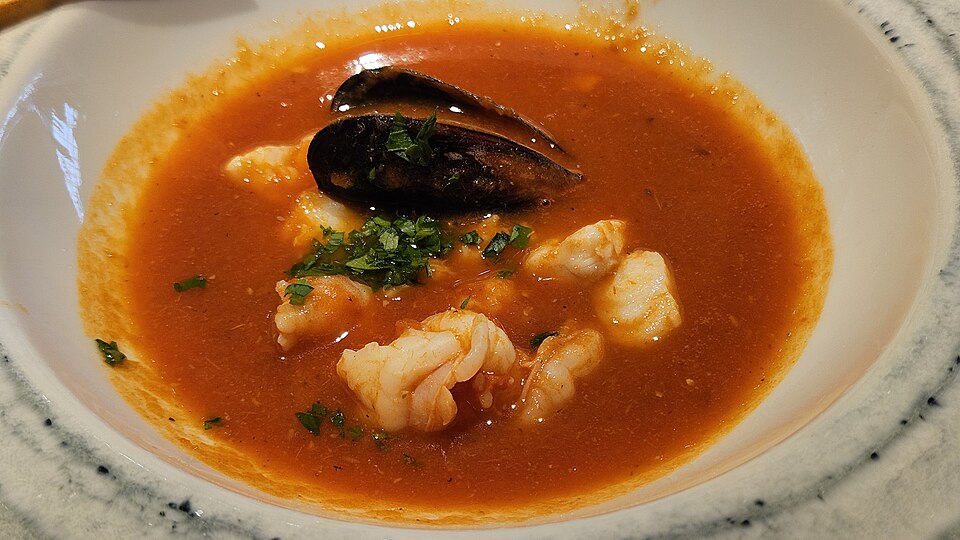
Home › Dishes › Bouillabaisse
Bouillabaisse at a glance
Glycemic index (est.)
20
low
Glycemic load / serving
4
low
Nutri-Score
A
A best, E worst
French cuisine · Contains Fish · Non-Vegetarian. Serving: 1 cup (approximately 240 ml).
Bouillabaisse nutrition per serving
| Nutrient | Per serving |
|---|
| Calories | 250 kcal |
| Protein | 25 g |
| Carbohydrate | 20 g |
| Fiber | 2 g |
| Sugars | 4 g |
| Added sugars | 0 g |
| Fat | 10 g |
| Saturated fat | 1.5 g |
| Sodium | 800 mg |
Typical ingredients: fish (such as cod, snapper, or other white fish), shellfish (such as mussels, shrimp, or crab), fish stock, tomatoes, onion, garlic, leeks, fennel, saffron, olive oil, orange peel, herbs (such as thyme and parsley), salt, pepper.
Similar French dishes with a lower glycemic load
Common questions about bouillabaisse
How many calories are in bouillabaisse?
NutriOptio estimates 250 calories in one serving (1 cup (approximately 240 ml)) of a typical bouillabaisse recipe. Your recipe and portion will change this.
Is bouillabaisse good for blood sugar?
A serving has an estimated glycemic load of 4, which is low (10 or under is low, 20 or over is high). Portion size and what you eat it with matter. This is general information, not medical advice.
What is the Nutri-Score of bouillabaisse?
NutriOptio grades a typical bouillabaisse A on Nutri-Score, where A is the best and E the lowest nutritional quality.
Log your own bouillabaisse
Your recipe is not the typical one. Photograph your plate or describe it, and NutriOptio grades your actual portion for glycemic load, Nutri-Score and processing.
Open the NutriOptio web app
How these numbers are made
These are the values the NutriOptio app gave for a typical bouillabaisse in October 2026. They are AI estimates and can change as the app is updated; search the dish in the app for its current estimate. Calories and nutrients are NutriOptio's AI estimate for a typical recipe and portion. The glycemic index is NutriOptio's reference value for this dish, estimated from its carbohydrate ingredients; glycemic load is computed from it and the serving's carbohydrate. Home and restaurant versions vary, sometimes a lot. General information, not medical advice.
All dishesFood listGlycemic load explained